Quadrature Methods
A crucial part of transport-map applications is selecting a suitable quadrature method. Quadrature is used in map optimization, in particular when evaluating the Kullback–Leibler divergence
Here,
In practice we approximate the integral by a quadrature sum:
The quadrature points
Especially in Bayesian inference, where evaluating the target density
Monte Carlo
Monte Carlo estimates an expectation
We start by loading the necessary packages:
using TransportMaps
using Plots

mc = MonteCarloWeights(500, 2)
p_mc = scatter(mc.points[:, 1], mc.points[:, 2], ms=3,
    label="MC samples", title="Monte Carlo (500 pts)", aspect_ratio=1)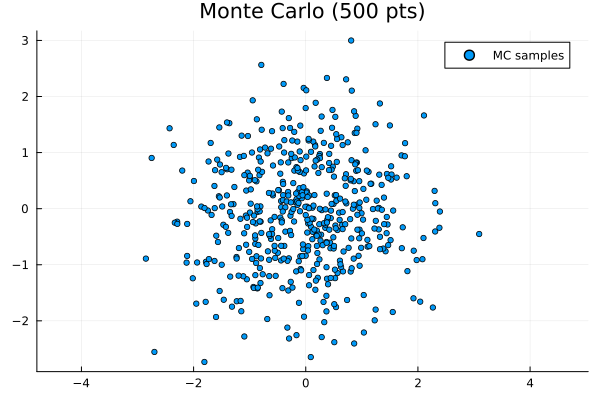
Latin Hypercube Sampling (LHS)
Latin Hypercube is a stratified sampling design that improves space-filling over plain Monte Carlo; weights remain uniform. It often reduces variance for low to moderate dimensions.
lhs = LatinHypercubeWeights(500, 2)
p_lhs = scatter(lhs.points[:, 1], lhs.points[:, 2], ms=3,
    label="LHS samples", title="Latin Hypercube (500 pts)", aspect_ratio=1)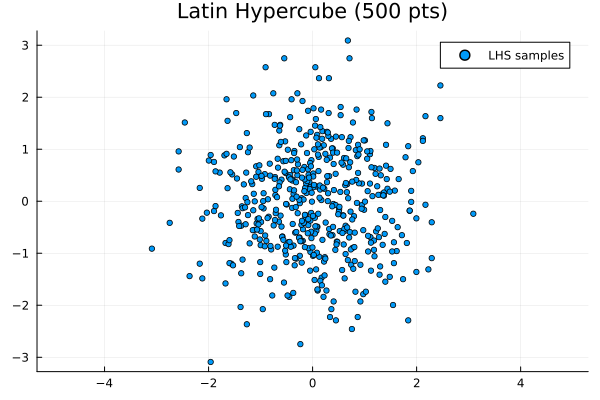
Tensor-product Gauss–Hermite
Gauss–Hermite quadrature provides nodes
hermite = GaussHermiteWeights(5, 2)
p_hermite = scatter(hermite.points[:, 1], hermite.points[:, 2],
    ms=4, label="Gauss–Hermite", title="Tensor Gauss–Hermite (5 × 5)", aspect_ratio=1)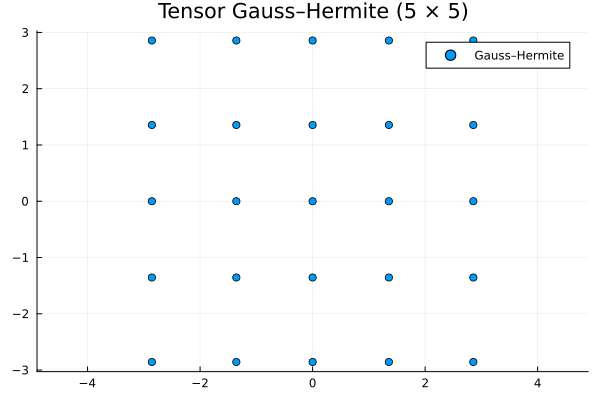
Sparse Smolyak Gauss–Hermite
Sparse Smolyak grids combine 1D quadrature rules across dimensions with carefully chosen coefficients to cancel redundant high-order interactions. The result is substantially fewer nodes than the full tensor product while retaining high accuracy for mixed smooth functions. Note that Smolyak quadrature can produce negative weights; this is expected for higher-order correction terms.
sparse = SparseSmolyakWeights(2, 2)
p_sparse = scatter(sparse.points[:, 1], sparse.points[:, 2], ms=6,
    label="Smolyak", title="Sparse Smolyak (level 2)", aspect_ratio=1)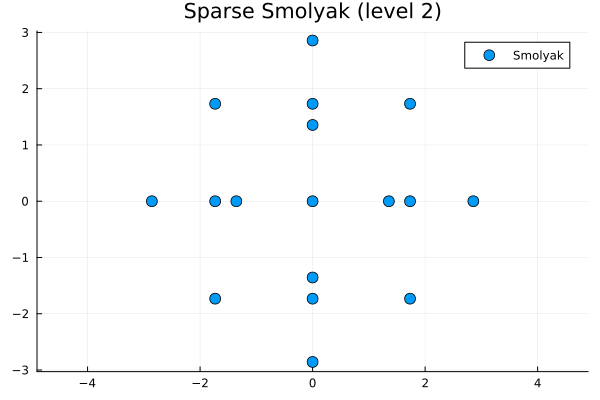
Quick usage notes
Use Monte Carlo or LHS for high-dimensional problems where deterministic quadrature is infeasible.
Use tensor Gauss–Hermite in very low dimensions when the integrand is smooth and high accuracy is required.
Use Sparse Smolyak for intermediate dimensions (e.g.
This page was generated using Literate.jl.