Optimization of the Map Coefficients
A crucial step in constructing transport maps is the optimization of the map coefficients, which determine how well the map represents the target distribution. This process can be approached in two distinct ways, depending on the available information about the target distribution [1].
Map-from-density
One way to construct a transport map is to directly optimize its parameters based on the (unnormalized) target density, as shown in Banana: Map from Density. This approach requires access to the target density function and uses quadrature schemes to approximate integrals, as introduced in Quadrature Methods.
Formally, we define the following optimization problem to determine the coefficients
As noted by [1], this optimization problem is generally non-convex. Specifically, it is only convex when the target density
In this package, map optimization is performed with the help of Optim.jl, and support a wide range of optimizers and options (such as convergence criteria and printing preferences). Specifically, we can pass our optimize! function the desired optimizer and options. For a full overview of available options, see the Optim.jl configuration documentation.
To perform the optimization of the map coefficients, we call:
optimize!(M::PolynomialMap, target_density::Function, quadrature::AbstractQuadratureWeights;
  optimizer::Optim.AbstractOptimizer = LBFGS(), options::Optim.Options = Optim.Options())
We have to provide the polynomial map M, the target density function, and a quadrature scheme. Optionally, we can specify the optimizer (default is LBFGS()) and options.
Set initial coefficients
As the starting point of the optimization, the map coefficients can be set using setcoefficients!(M, coeffs), where coeffs is a vector of coefficients.
Usage
First we load the packages:
using TransportMaps
using Optim
using Distributions
using Plots
Then, define the target density and quadrature scheme. Here, we use the same banana-shaped density as in Banana: Map from Density:
banana_density(x) = logpdf(Normal(), x[1]) + logpdf(Normal(), x[2] - x[1]^2)
target = MapTargetDensity(banana_density)
quadrature = GaussHermiteWeights(3, 2)
Set optimization options to print the trace every 20 iterations:
opts_trace = Optim.Options(iterations=200, show_trace=true, show_every=20, store_trace=true) x_abstol = 0.0
x_reltol = 0.0
f_abstol = 0.0
f_reltol = 0.0
g_abstol = 1.0e-8
outer_x_abstol = 0.0
outer_x_reltol = 0.0
outer_f_abstol = 0.0
outer_f_reltol = 0.0
outer_g_abstol = 1.0e-8
f_calls_limit = 0
g_calls_limit = 0
h_calls_limit = 0
allow_f_increases = true
allow_outer_f_increases = true
successive_f_tol = 1
iterations = 200
outer_iterations = 1000
store_trace = true
trace_simplex = false
show_trace = true
extended_trace = false
show_warnings = true
show_every = 20
callback = nothing
time_limit = NaNWe will try the following optimizers from Optim.jl, ordered from simplest to most sophisticated:
Gradient Descent
The most basic optimization algorithm, Gradient Descent iteratively moves in the direction of the negative gradient. It is simple and robust, but can be slow to converge, especially for ill-conditioned problems.
M_gd = PolynomialMap(2, 2)
res_gd = optimize!(M_gd, target, quadrature; optimizer=GradientDescent(), options=opts_trace)
println(res_gd)
Iter Function value Gradient norm
0 3.397609e+00 4.804530e-01
* time: 4.9114227294921875e-5
20 2.848534e+00 3.621462e-02
* time: 0.49854397773742676
40 2.842619e+00 1.638872e-02
* time: 0.8146162033081055
60 2.841176e+00 1.166967e-02
* time: 1.095919132232666
80 2.840287e+00 7.557780e-03
* time: 1.4471321105957031
100 2.839999e+00 6.787106e-03
* time: 1.7370281219482422
120 2.839847e+00 4.380257e-03
* time: 2.006965160369873
140 2.839699e+00 2.781420e-03
* time: 2.3540070056915283
160 2.839650e+00 1.633244e-03
* time: 2.701019048690796
180 2.839638e+00 1.294863e-03
* time: 2.996162176132202
200 2.839629e+00 9.626051e-04
* time: 3.299962043762207
┌ Warning: Optimization has not converged.
└ @ TransportMaps ~/work/TransportMaps.jl/TransportMaps.jl/src/optimization/mapfromdensity.jl:158
* Status: failure (reached maximum number of iterations)
* Candidate solution
Final objective value: 2.839629e+00
* Found with
Algorithm: Gradient Descent
* Convergence measures
|x - x'| = 1.59e-04 ≰ 0.0e+00
|x - x'|/|x'| = 6.46e-05 ≰ 0.0e+00
|f(x) - f(x')| = 2.01e-07 ≰ 0.0e+00
|f(x) - f(x')|/|f(x')| = 7.07e-08 ≰ 0.0e+00
|g(x)| = 9.63e-04 ≰ 1.0e-08
* Work counters
Seconds run: 3 (vs limit Inf)
Iterations: 200
f(x) calls: 425
∇f(x) calls: 425
∇f(x)ᵀv calls: 0Conjugate Gradient
Conjugate Gradient improves upon basic gradient descent by using conjugate directions, which can accelerate convergence for large-scale or quadratic problems. It requires gradient information but not the Hessian.
M_cg = PolynomialMap(2, 2)
res_cg = optimize!(M_cg, target, quadrature; optimizer=ConjugateGradient(), options=opts_trace)
println(res_cg)
Iter Function value Gradient norm
0 3.397609e+00 4.804530e-01
* time: 4.601478576660156e-5
20 2.839618e+00 7.867679e-05
* time: 0.4015500545501709
40 2.839618e+00 2.757371e-07
* time: 0.5797040462493896
* Status: success
* Candidate solution
Final objective value: 2.839618e+00
* Found with
Algorithm: Conjugate Gradient
* Convergence measures
|x - x'| = 1.46e-09 ≰ 0.0e+00
|x - x'|/|x'| = 5.87e-10 ≰ 0.0e+00
|f(x) - f(x')| = 0.00e+00 ≤ 0.0e+00
|f(x) - f(x')|/|f(x')| = 0.00e+00 ≤ 0.0e+00
|g(x)| = 1.25e-08 ≰ 1.0e-08
* Work counters
Seconds run: 1 (vs limit Inf)
Iterations: 58
f(x) calls: 118
∇f(x) calls: 64
∇f(x)ᵀv calls: 0Nelder-Mead
Nelder-Mead is a derivative-free optimizer that uses a simplex of points to search for the minimum. It is useful when gradients are unavailable or unreliable, but may be less efficient for high-dimensional or smooth problems.
M_nm = PolynomialMap(2, 2)
res_nm = optimize!(M_nm, target, quadrature; optimizer=NelderMead(), options=opts_trace)
println(res_nm)
Iter Function value √(Σ(yᵢ-ȳ)²)/n
------ -------------- --------------
0 3.385910e+00 6.615819e-03
* time: 6.008148193359375e-5
20 3.325358e+00 1.182567e-02
* time: 0.04494118690490723
40 3.217377e+00 1.768618e-02
* time: 0.08356904983520508
60 3.145705e+00 4.179719e-03
* time: 0.14801311492919922
80 3.117396e+00 5.441360e-03
* time: 0.17565298080444336
100 3.093641e+00 3.315425e-03
* time: 0.20177507400512695
120 3.070293e+00 3.700208e-03
* time: 0.24345111846923828
140 3.052176e+00 3.555031e-03
* time: 0.2709681987762451
160 3.040402e+00 2.725353e-03
* time: 0.2995901107788086
180 3.027753e+00 2.904953e-03
* time: 0.34148597717285156
200 3.012278e+00 2.578709e-03
* time: 0.36596012115478516
┌ Warning: Optimization has not converged.
└ @ TransportMaps ~/work/TransportMaps.jl/TransportMaps.jl/src/optimization/mapfromdensity.jl:158
* Status: failure (reached maximum number of iterations)
* Candidate solution
Final objective value: 3.012278e+00
* Found with
Algorithm: Nelder-Mead
* Convergence measures
√(Σ(yᵢ-ȳ)²)/n ≰ 1.0e-08
* Work counters
Seconds run: 0 (vs limit Inf)
Iterations: 200
f(x) calls: 305BFGS
BFGS is a quasi-Newton method that builds up an approximation to the Hessian matrix using gradient evaluations. It is generally faster and more robust than gradient descent and conjugate gradient for smooth problems.
M_bfgs = PolynomialMap(2, 2)
res_bfgs = optimize!(M_bfgs, target, quadrature; optimizer=BFGS(), options=opts_trace)
println(res_bfgs)
Iter Function value Gradient norm
0 3.397609e+00 4.804530e-01
* time: 6.198883056640625e-5
* Status: success
* Candidate solution
Final objective value: 2.839618e+00
* Found with
Algorithm: BFGS
* Convergence measures
|x - x'| = 2.08e-07 ≰ 0.0e+00
|x - x'|/|x'| = 8.37e-08 ≰ 0.0e+00
|f(x) - f(x')| = 3.55e-15 ≰ 0.0e+00
|f(x) - f(x')|/|f(x')| = 1.25e-15 ≰ 0.0e+00
|g(x)| = 1.73e-09 ≤ 1.0e-08
* Work counters
Seconds run: 0 (vs limit Inf)
Iterations: 16
f(x) calls: 19
∇f(x) calls: 19
∇f(x)ᵀv calls: 0LBFGS
LBFGS is a limited-memory version of BFGS, making it suitable for large-scale problems where storing the full Hessian approximation is impractical. It is the default optimizer in many scientific computing packages due to its efficiency and reliability.
M_lbfgs = PolynomialMap(2, 2)
res_lbfgs = optimize!(M_lbfgs, target, quadrature; optimizer=LBFGS(), options=opts_trace)
println(res_lbfgs)
Iter Function value Gradient norm
0 3.397609e+00 4.804530e-01
* time: 0.00010704994201660156
* Status: success
* Candidate solution
Final objective value: 2.839618e+00
* Found with
Algorithm: L-BFGS
* Convergence measures
|x - x'| = 3.06e-08 ≰ 0.0e+00
|x - x'|/|x'| = 1.23e-08 ≰ 0.0e+00
|f(x) - f(x')| = 4.44e-16 ≰ 0.0e+00
|f(x) - f(x')|/|f(x')| = 1.56e-16 ≰ 0.0e+00
|g(x)| = 3.21e-09 ≤ 1.0e-08
* Work counters
Seconds run: 0 (vs limit Inf)
Iterations: 17
f(x) calls: 22
∇f(x) calls: 22
∇f(x)ᵀv calls: 0Finally, we can compare the results by means of variance diagnostic:
samples_z = randn(1000, 2)
v_gd = variance_diagnostic(M_gd, target, samples_z)
v_cg = variance_diagnostic(M_cg, target, samples_z)
v_nm = variance_diagnostic(M_nm, target, samples_z)
v_bfgs = variance_diagnostic(M_bfgs, target, samples_z)
v_lbfgs = variance_diagnostic(M_lbfgs, target, samples_z)

println("Variance diagnostic GradientDescent:   ", v_gd)
println("Variance diagnostic ConjugateGradient: ", v_cg)
println("Variance diagnostic NelderMead:        ", v_nm)
println("Variance diagnostic BFGS:              ", v_bfgs)
println("Variance diagnostic LBFGS:             ", v_lbfgs)
Variance diagnostic GradientDescent: 0.00043084081882018054
Variance diagnostic ConjugateGradient: 0.0004262576724235596
Variance diagnostic NelderMead: 0.1050219660068103
Variance diagnostic BFGS: 0.00042625774960900907
Variance diagnostic LBFGS: 0.0004262577780411096We can visualize the convergence of all optimizers:
plot([res_gd.trace[i].iteration for i in 1:length(res_gd.trace)], lw=2,
    [res_gd.trace[i].g_norm for i in 1:length(res_gd.trace)], label="GradientDescent")
plot!([res_cg.trace[i].iteration for i in 1:length(res_cg.trace)], lw=2,
    [res_cg.trace[i].g_norm for i in 1:length(res_cg.trace)], label="ConjugateGradient")
plot!([res_nm.trace[i].iteration for i in 1:length(res_nm.trace)], lw=2,
    [res_nm.trace[i].g_norm for i in 1:length(res_nm.trace)], label="NelderMead")
plot!([res_bfgs.trace[i].iteration for i in 1:length(res_bfgs.trace)], lw=2,
    [res_bfgs.trace[i].g_norm for i in 1:length(res_bfgs.trace)], label="BFGS")
plot!([res_lbfgs.trace[i].iteration for i in 1:length(res_lbfgs.trace)], lw=2,
    [res_lbfgs.trace[i].g_norm for i in 1:length(res_lbfgs.trace)], label="LBFGS")
plot!(xaxis=:log, yaxis=:log, xlabel="Iteration", ylabel="Gradient norm",
    title="Convergence of different optimizers", xlims=(1, 200),
    legend=:bottomleft)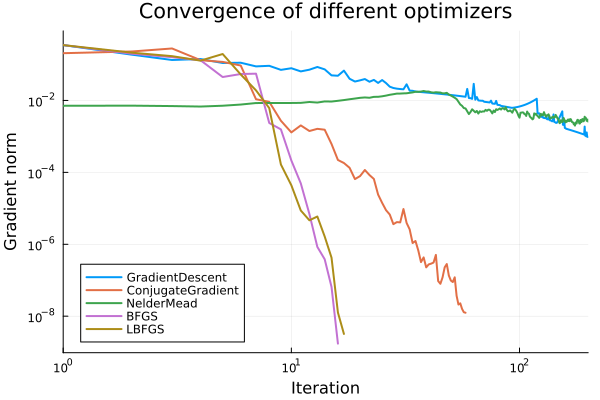
It becomes clear, that LBFGS and BFGS are the most efficient optimizers in this case, while Nelder-Mead struggles to keep up.
Map-from-samples
Another strategy of constructing a transport map is to use samples of the target density, as seen in Banana: Map from Samples. The formulation of transport map estimation in this way has the benefit to transform the problem into a convex optimization problem, when reference density is log-concave [1]. Since we can choose the reference density, we can leverage this property to simplify the optimization process.
When the map is constructed from samples, the optimization problem is formulated by minimizing the Kullback-Leibler divergence between the pushforward of the reference density and the empirical distribution of the samples. We denote the transport map by
where
To perform the optimization, we can use the same optimize! function as before, but now we pass samples instead of a target density and quadrature scheme. Similarly, we can specify the optimizer and options:
optimize!(M::PolynomialMap, samples::AbstractArray{<:Real};
  optimizer::Optim.AbstractOptimizer = LBFGS(), options::Optim.Options = Optim.Options())
This page was generated using Literate.jl.