Quadrature Methods
A crucial part of transport-map applications is selecting a suitable quadrature method. Quadrature is used in map optimization, in particular when evaluating the Kullback–Leibler divergence
Here,
In practice we approximate the integral by a quadrature sum:
The quadrature points
Especially in Bayesian inference, where evaluating the target density
Reference Density and Quadrature Choice
Since quadrature is performed in the reference space
| Quadrature rule | Reference | Notes |
|---|---|---|
MonteCarloWeights | any (default: | Uses random sampling from the default reference |
LatinHypercubeWeights | any (default: | Quasi-random sampling from the default reference |
TensorProductWeights | any | Quadrature by full tensor-product of one-dimensional quadrature rule |
GaussHermiteWeights | Tensor-product Gauss-Hermite quadrature | |
GaussLegendreWeights | Tensor-product Gauss-Legendre quadrature | |
SparseSmolyakWeights | any (default: | Sparse grid quadrature rule; fewer points than full tensor product |
Sampling-based Quadrature
Monte Carlo
Monte Carlo estimates an expectation by sampling from the reference density (default Normal() for MonteCarloWeights(n, d)) and forming the sample average. It is simple and robust; weights are uniform. Convergence is stochastic (
mc = MonteCarloWeights(500, 2)
scatter(mc.points[:, 1], mc.points[:, 2], ms=3,
    label="MC samples", title="Monte Carlo (500 pts)", aspect_ratio=1)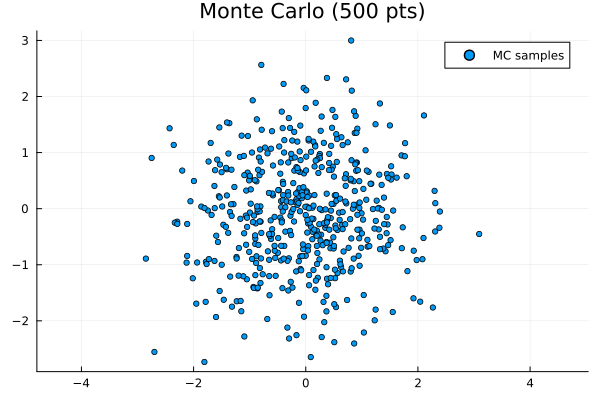
Latin Hypercube Sampling
Latin Hypercube is a stratified sampling design that improves space-filling over plain Monte Carlo; weights remain uniform. It often reduces variance for low to moderate dimensions.
lhs = LatinHypercubeWeights(500, 2)
scatter(lhs.points[:, 1], lhs.points[:, 2], ms=3,
    label="LHS samples", title="Latin Hypercube (500 pts)", aspect_ratio=1)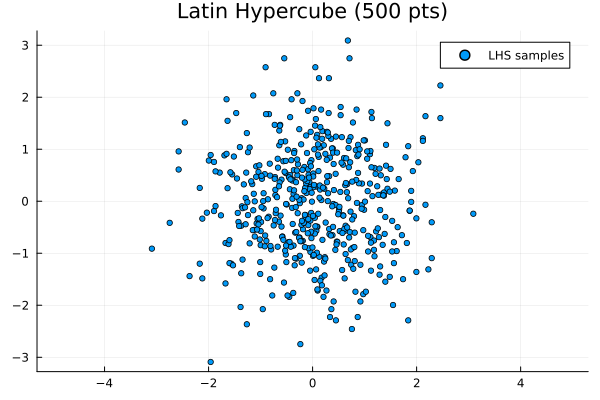
Tensor-Product Quadrature
Tensor-product quadrature constructs multidimensional rules by combining one-dimensional quadrature rules across each coordinate. Given a 1D rule with
General tensor-product quadrature is performed with TensorProductWeights:
quad = TensorProductWeights(level, dim, knots)Different knot choices are available: GaussHermiteKnots(), GaussLegendreKnots(), ClenshawCurtisKnots()
Tensor-product Gauss–Hermite
Gauss–Hermite quadrature is optimized for Gaussian reference measures on
hermite = GaussHermiteWeights(3, 2)
# alias: TensorProductWeights(3, 2, GaussHermiteKnots())
scatter(hermite.points[:, 1], hermite.points[:, 2],
    ms=4, label="Gauss–Hermite", title="Tensor Gauss–Hermite (level 3)", aspect_ratio=1)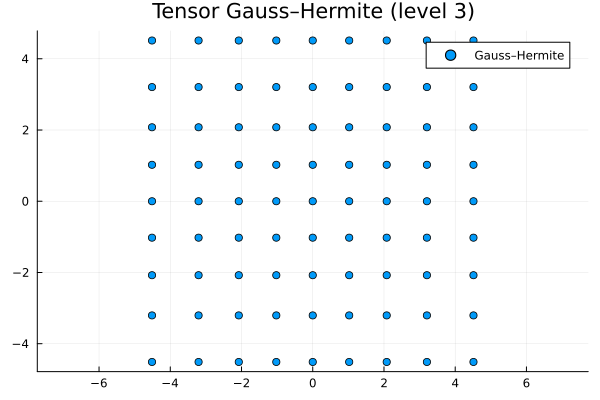
Tensor-product Gauss-Legendre
Gauss–Legendre quadrature is optimized for bounded uniform reference measures on
legendre = GaussLegendreWeights(3, 2)
# alias: TensorProductWeights(3, 2, GaussLegendreKnots())
scatter(legendre.points[:, 1], legendre.points[:, 2],
    ms=4, label="Gauss–Legendre", title="Tensor Gauss–Legendre (level 3) on [-1, 1]", aspect_ratio=1)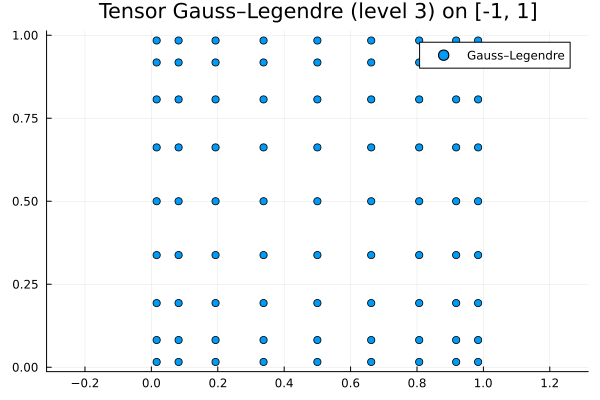
legendre_scaled = GaussLegendreWeights(3, 2, [0, 1])
scatter(legendre_scaled.points[:, 1], legendre_scaled.points[:, 2],
    ms=4, label="Gauss–Legendre", title="Tensor Gauss–Legendre (level 3) on [0, 1]", aspect_ratio=1)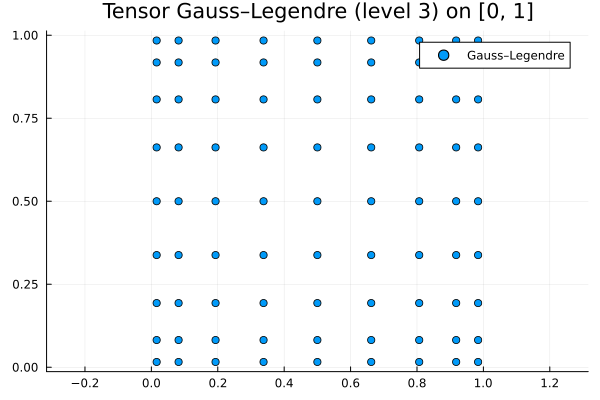
Sparse-Grid Quadrature
Sparse-grid methods reduce the number of quadrature points compared to full tensor products while maintaining accuracy for smooth functions.
Sparse Smolyak grids use carefully chosen coefficients to cancel redundant high-dimensional interactions, reducing points from
Different knot choices (GaussHermiteKnots(), GaussLegendreKnots(), ClenshawCurtisKnots()) optimize sparse grids for different reference measures, similar to their tensor-product counterparts:
sparse = SparseSmolyakWeights(3, 2) # knots = GaussHermiteKnots()
scatter(sparse.points[:, 1], sparse.points[:, 2], ms=6,
    label="Smolyak", title="Sparse Smolyak GaussHermiteKnots", aspect_ratio=1)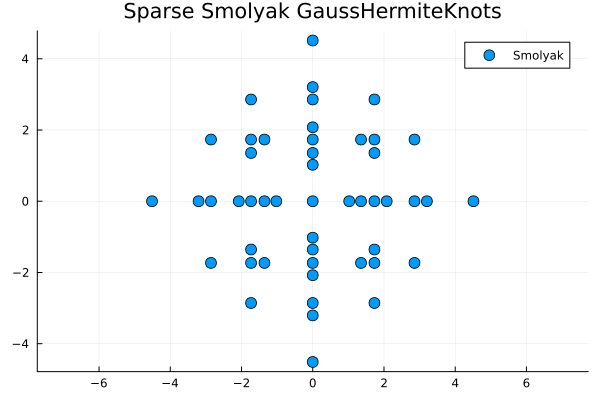
sparse_legendre = SparseSmolyakWeights(3, 2, GaussLegendreKnots())
scatter(sparse_legendre.points[:, 1], sparse_legendre.points[:, 2], ms=6,
    label="Smolyak", title="Sparse Smolyak GaussLegendreKnots", aspect_ratio=1)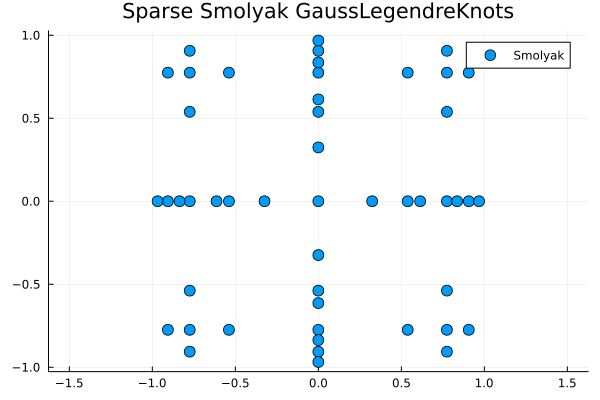
sparse_cc= SparseSmolyakWeights(3, 2, ClenshawCurtisKnots())
scatter(sparse_cc.points[:, 1], sparse_cc.points[:, 2], ms=6,
    label="Smolyak", title="Sparse Smolyak ClenshawCurtisKnots", aspect_ratio=1)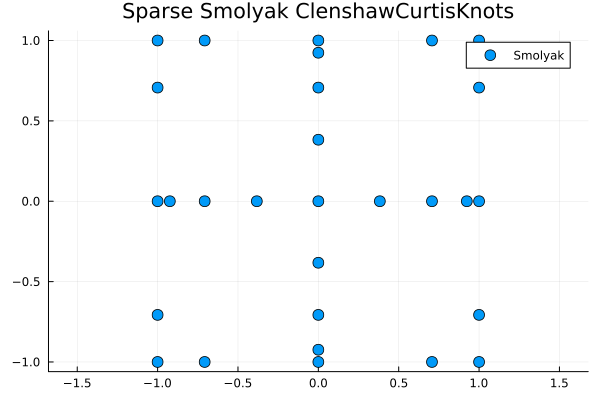
This page was generated using Literate.jl.