
Fire Protection Credal Network
This example models fire safety in a building. A fire may produce smoke and set off an alarm; the alarm can also be triggered by tampering. Smoke prompts the occupants to leave, and neighbours may report the accident. Every conditional probability is known only up to an interval rather than a single number, so the model is a CredalNetwork (CN) and inference returns probability bounds instead of point values.
The network and the probability intervals below are the benchmark of Estrada-Lugo, Tolo, De Angelis & Patelli [17] (their "small-interval" parameterisation), which lets us check the bounds computed here against their published results.
using EnhancedBayesianNetworksRoot nodes
Both roots are imprecise: a recent tampering event, and an actual fire.
T = DiscreteNode(:Tampering)
T[:Tampering => :YesT] = Interval(0.00889, 0.01001)
T[:Tampering => :NoT] = Interval(0.98999, 0.99111)

F = DiscreteNode(:Fire)
F[:Fire => :YesF] = Interval(0.040011, 0.041022)
F[:Fire => :NoF] = Interval(0.958978, 0.959989)
[0.958978, 0.959989]Alarm
The alarm depends on both Tampering and Fire.
A = DiscreteNode(:Alarm, [:Tampering, :Fire])
A[:Tampering => :YesT, :Fire => :YesF, :Alarm => :YesA] = Interval(0.564106, 0.6)
A[:Tampering => :YesT, :Fire => :YesF, :Alarm => :NoA] = Interval(0.4, 0.435894)
A[:Tampering => :YesT, :Fire => :NoF, :Alarm => :YesA] = Interval(0.880001, 0.9)
A[:Tampering => :YesT, :Fire => :NoF, :Alarm => :NoA] = Interval(0.1, 0.119999)
A[:Tampering => :NoT, :Fire => :YesF, :Alarm => :YesA] = Interval(0.987342, 0.99)
A[:Tampering => :NoT, :Fire => :YesF, :Alarm => :NoA] = Interval(0.01, 0.012658)
A[:Tampering => :NoT, :Fire => :NoF, :Alarm => :YesA] = Interval(0.000003, 0.0002)
A[:Tampering => :NoT, :Fire => :NoF, :Alarm => :NoA] = Interval(0.9998, 0.999997)
[0.9998, 0.999997]Smoke, Leaving and Report
The remaining nodes form a chain: Fire → Smoke, and Alarm → Leaving → Report.
S = DiscreteNode(:Smoke, [:Fire])
S[:Fire => :YesF, :Smoke => :YesS] = Interval(0.89, 0.91)
S[:Fire => :YesF, :Smoke => :NoS] = Interval(0.09, 0.11)
S[:Fire => :NoF, :Smoke => :YesS] = Interval(0.01, 0.102469)
S[:Fire => :NoF, :Smoke => :NoS] = Interval(0.897531, 0.915557)

L = DiscreteNode(:Leaving, [:Alarm])
L[:Alarm => :YesA, :Leaving => :YesL] = Interval(0.870001, 0.9)
L[:Alarm => :YesA, :Leaving => :NoL] = Interval(0.1, 0.129999)
L[:Alarm => :NoA, :Leaving => :YesL] = Interval(0.400001, 0.414423)
L[:Alarm => :NoA, :Leaving => :NoL] = Interval(0.585577, 0.599999)

R = DiscreteNode(:Report, [:Leaving])
R[:Leaving => :YesL, :Report => :YesR] = Interval(0.75, 0.759989)
R[:Leaving => :YesL, :Report => :NoR] = Interval(0.240011, 0.25)
R[:Leaving => :NoL, :Report => :YesR] = Interval(0.171101, 0.190012)
R[:Leaving => :NoL, :Report => :NoR] = Interval(0.809988, 0.828899)
[0.809988, 0.828899]Assembling the Credal Network
Because the nodes are imprecise, they are wrapped in a CredalNetwork rather than a BayesianNetwork.
cn = CredalNetwork([T, F, A, S, L, R])
add_child!(cn, :Tampering, :Alarm)
add_child!(cn, :Fire, :Alarm)
add_child!(cn, :Fire, :Smoke)
add_child!(cn, :Alarm, :Leaving)
add_child!(cn, :Leaving, :Report)
order!(cn)

gplot(cn, background_color = "white", legend = true, label_size = 10, legend_x = 14.5, legend_y = 13.5)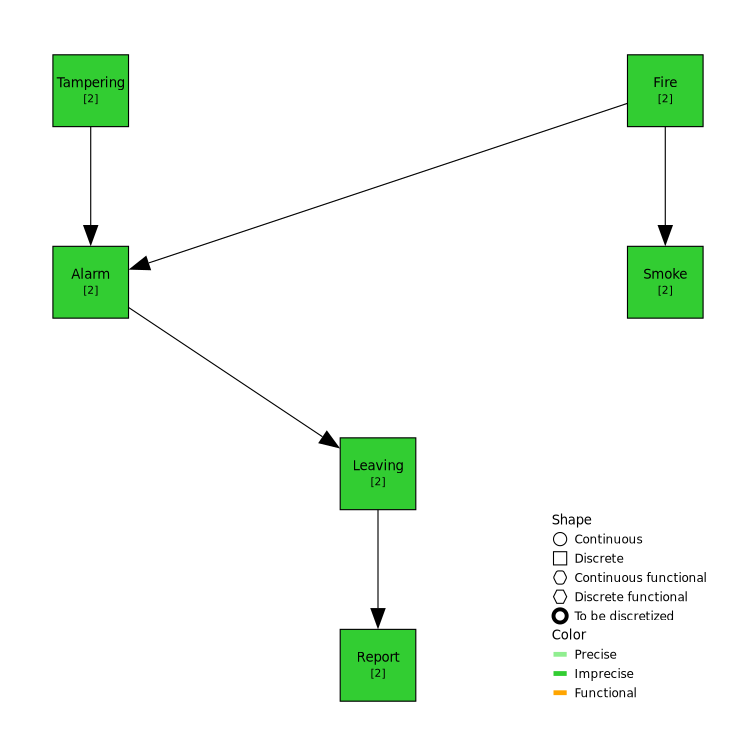
Inference without evidence
For a Credal Network infer returns bounds: the lowest and highest probability of each state across the whole family of networks.
infer(cn, [:Smoke], Evidence())CredalPosterior P(Smoke)
Smoke Interval
------------------------
YesS [0.116674, 0.135596]
NoS [0.864404, 0.883326]
Extreme posteriors: 4096infer(cn, [:Report], Evidence())CredalPosterior P(Report)
Report Interval
------------------------
YesR [0.415413, 0.439863]
NoR [0.560137, 0.584587]
Extreme posteriors: 4096infer(cn, [:Alarm], Evidence())CredalPosterior P(Alarm)
Alarm Interval
------------------------
YesA [0.046867, 0.0492809]
NoA [0.950719, 0.953133]
Extreme posteriors: 4096infer(cn, [:Leaving], Evidence())CredalPosterior P(Leaving)
Leaving Interval
------------------------
YesL [0.422029, 0.438353]
NoL [0.561647, 0.577971]
Extreme posteriors: 4096Inference with evidence
Conditioning shifts and tightens the bounds. Given that a fire has broken out, how likely are the occupants to leave, and to report?
infer(cn, [:Leaving], Evidence(:Fire => :YesF))CredalPosterior P(Leaving | Fire=YesF)
Leaving Interval
------------------------
YesL [0.862061, 0.893461]
NoL [0.106539, 0.137939]
Extreme posteriors: 4096infer(cn, [:Report], Evidence(:Fire => :YesF))CredalPosterior P(Report | Fire=YesF)
Report Interval
------------------------
YesR [0.670147, 0.699264]
NoR [0.300736, 0.329853]
Extreme posteriors: 4096infer(cn, [:Report], Evidence(:Alarm => :YesA))CredalPosterior P(Report | Alarm=YesA)
Report Interval
------------------------
YesR [0.674744, 0.702991]
NoR [0.297009, 0.325256]
Extreme posteriors: 4096Reasoning diagnostically: having observed the occupants leaving, what are the bounds on there being a fire?
infer(cn, [:Fire], Evidence(:Leaving => :YesL))CredalPosterior P(Fire | Leaving=YesL)
Fire Interval
------------------------
YesF [0.0790652, 0.0864259]
NoF [0.913574, 0.920935]
Extreme posteriors: 4096Validation
These are exactly the eight queries reported by Estrada-Lugo et al. [17] (four without evidence, four with), whose "Exact" bounds the values above reproduce.
Timing
As a rough indication, the wall-clock time to answer one query after compilation — measured on the machine building these docs, so treat it as indicative rather than a controlled benchmark:
infer(cn, [:Fire], Evidence(:Leaving => :YesL))   # warm up (trigger compilation)
elapsed = @elapsed infer(cn, [:Fire], Evidence(:Leaving => :YesL))
println("query solved in ", round(elapsed * 1.0e3; digits = 3), " ms")
query solved in 474.121 msThis page was generated using Literate.jl.